

The End of the World
- Dec 3, 2017
- 4 min read
"In the long run, we are all dead" - John Maynard Keynes
• Warning: Contains spoilers of the 2nd episode of the 1st series of the BBC Wales - produced Doctor Who

The year 5,000,000,000–the imagined end of the world from the Sun expanding into a red giant and consuming the earth according to the TV show, Doctor Who. Humanity seems to be obsessed with the idea of death of its species, reflecting its fear primarily in the media through movies like Armageddon and shows like The Walking Dead. This is not exactly unsubstantiated, just maybe a bit exaggerated. You see, people have claimed to know the date of the end of life as we know it for millenia, from religious claims of the apocalypse to scientific predictions of the eventual collapse of the universe (of course, assuming we don’t kill our selves first in a nuclear war or in a carbon dioxide related catastrophe). Whatever one believes, the fact that the human empire will eventually fall into ruins rings true. Rather morbid, but necessary to think about.
As Professor Steintrager from the University of California, Irvine English department claims, ruins are good for thinking. They force the viewer to contemplate the value of one’s life and the consequences of one’s actions. However, we do not often encounter such deep thinking because, quite frankly, nobody wants to think about their species’ certain doom and the few examples that we do see in Hollywood representations often involve somehow overcoming certain doom, such as in the movie 2012.
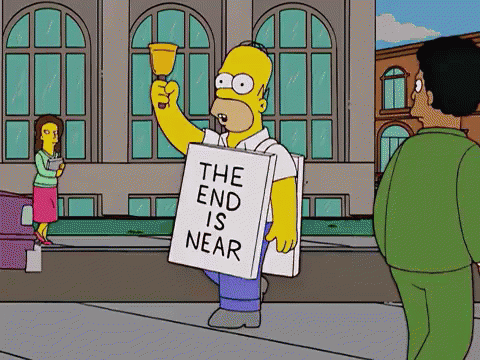
The entertainment industry thrives upon shows and movies that captivate the audience, but rarely do we see meaningful content, particularly something as morbid as the end of humanity, in common media. For obvious reasons, they fear losing audience attention or offending the viewers, both of which would be bad for ratings and business. Doctor Who, however, rejects the norm and dares to criticize human actions in almost all of its episodes, often conveying warnings about the dangers of human habits in worst case scenario stories involving aliens, time/space travel, and British humor. Simultaneously, it forces the viewers to consider their mortality–that everything we are and everything we have will one day disappear.
The show revolves around choices and the Doctor, while the moral center of the program and clearly a compassionate character, demonstrates that there may not always be a right choice, but a choice must nevertheless be made. The BBC Wales-produced Doctor Who starts with the 9th Doctor–a legendary entity who travels in his spaceship called the Tardis, offering aid to creatures who need help. The Doctor takes on companions, such as Rose Tyler–the friend of the 9th and 10th incarnations–to share his adventures and potentially show a human being the consequences of the actions of their race.
I found the second episode the most interesting and thought provoking. The 9th Doctor takes his companion Rose on her first adventure through space and time and decides that the most interesting starting point would be the end of the world (in retrospect, perhaps not the best idea). Creatures from across the universe (well, the ones rich enough to buy a ticket on board at least) come to watch the catastrophic beauty of the sun consuming the earth. The last fully human being, Cassandra, comes to watch her home planet implode, and her grotesque appearance–that of a piece of skin stretched out on a frame–shocks both the audience and the Doctor’s companion.
The episode takes two primary things into consideration–the, often horrific, extent to which humans will go to preserve their own well-being and that all things come to an end. However, the show points out that the latter message does not have to be a bad thing. As a matter of fact, it is the knowledge that we will one day lose everything that makes what we have all the more precious, as demonstrated by Rose’s greater wonderment towards her adventures and her increased affection towards her mother.
The former message, on the other hand, acts as a major criticism for expansionism. Cassandra attempts to kill all those on board so that she can take over their corporate holdings, placing money and the continuation of her flimsy life above the lives of others, willing to risk war and the downfall of entire species for her profit. She acts similarly to the Manifest Destiny proponents of the United States, who used pre-determination and white superiority as flimsy excuses to take over native land for personal profit.
While the drama goes on and the Doctor defeats Cassandra, the end of the world occurred while no one was watching. The show attempts to use this moment to convey symbolically the direction in which humans are headed–how we may soon come to the end of our world without noticing because we were too busy attempting to save ourselves and feed our greed to care for what we had done to our home. So, our generation and many generations after us likely will not live to see our world and universe end, but does that mean we shouldn’t care if our actions potentially cause the extinction of our species in the long run? And, in the short run, how far are we willing to go to destroy others as long as it benefits ourselves? Watch the episode and see what you think–perhaps watching the end of the world will inspire some thoughts.
Works Cited
Appell, David. “The Sun Will Eventually Engulf Earth--
Maybe.” Scientific American, Nature America, 1
Sept. 2008, www.scientificamerican.com/article/the-
sun-will-eventually-engulf-earth-maybe/.
Barboza, David. “In Chinese Factories, Lost Fingers
and Low Pay.” The New York Times, The New York
Times, 4 Jan. 2008,
www.nytimes.com/2008/01/05/business/worldbusine
ss/05sweatshop.html.
Davies, Russell T. “The End of the World.” Doctor
Who, season 1, episode 2, BBC Wales, 17 Mar. 2006.
Hartsfield, Tom. “Heat Death: The Ultimate Fate of Our
Universe.” Real Clear Science, RealClearScience, 4
Dec. 2013,
www.realclearscience.com/blog/2013/12/heat_death
_the_ultimate_fate_of_our_universe.html.
Louise, Rita. “The Apocalypse: Predictions Of The End
Of The World.” Soul Healer, Rita Louise, 8 Dec.
2015, soulhealer.com/apocalypse-predictions-end-
of-the-world/.
O'Callaghan, Jonathan. “Life after a Nuclear War
Revealed: Computer Models Reveal Earth Would
Suffer a 20-Year-Long Winter and Worldwide
Famine.” Daily Mail Online, Associated Newspapers,
21 July 2014,
www.dailymail.co.uk/sciencetech/article-
2699854/Life-nuclear-war-revealed-Computer-
models-reveal-Earth-suffer-20-year-long-winter-
worldwide-famine.html.
Riebeek, Holli. “The Carbon Cycle : Feature
Articles.” NASA, NASA, 16 July 2011,
earthobservatory.nasa.gov/Features/CarbonCycle/p
age5.php.
Comments