


Schrödinger’s Girl
- Nov 20, 2017
- 4 min read
“You start with something pure. Something exciting. Then come the mistakes, the compromises. We create our own demons.” - “Iron Man 2”

Everything comes at a cost.
The imperialist project, the Roman Empire, and the Nazi expedition all started with an idea of basic self-preservation, but very quickly that idea twisted into something cruel. For the imperialists, they wanted to better their own nation with resources from other lands, but took advantage of the natives and caused much of the discord in less developed nations that we still see today. The Romans began by finding and defending their home, but as their greed grew, they decimated their enemies and their own armies in an effort to expand their territories. The Nazi’s grew out of an ideology that wanted to repair their nation in the aftermath of the retributive policies of World War I, but ended up scapegoating Jews for the collapse of the nation and performed perhaps the most horrific genocide in history, the Holocaust.

Philosophers have contemplated empires and their ruins for centuries, from Jean-Jacques Rousseau with his discourses on human inequality, to J.M. Coetzee with his novel, Waiting for the Barbarians, to Virgil with his epic, The Aeneid. In all cases, the theory of empire requires a sacrifice, whether it be of morals, freedom, or happiness respectively. For the creators of Schindler’s List, the human sacrifice could not be ignored. In essence, empire represents a pyrrhic victory, in which the cost to both the victors and the “others” exceeds the benefits reaped.
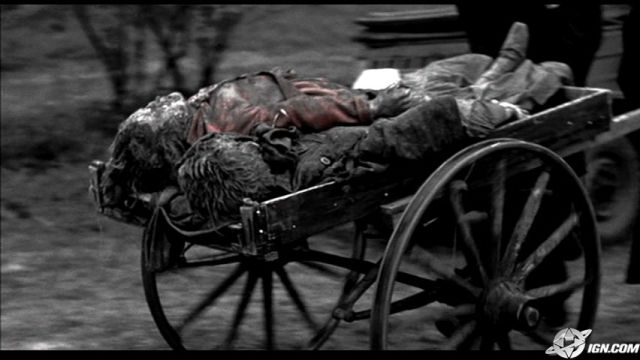
The girl in the red coat is an iconic image in Schindler’s List, emulating the cost of neutrality–of pretending that as long as one is not participating the crime, one is not a criminal. When Amon Göth, a second lieutenant of the SS (Hitler's paramilitary force), orders the massacre of a ghetto to make way for the Plaszów concentration camp, Oskar Schindler, a man who initially enters the scene to profit off of the anti-semitic views, undergoes a massive metamorphosis, the image of the girl, first hiding from the Nazis and then her dead body carried off in a wagon, burned into his memory forever.
In the film strip, the girl’s coat is the only thing in color–in a bright, bloody red, perhaps representing the blood on the hands of the Nazis. There are no features distinguishing her as Jewish or German and no sign of the famous inverted swastika. She acts as a dual symbol for the naïve innocence that died in the Nazi war effort and also for a call to action against injustice. Schindler sees her as both, understanding her as a representative for all the crimes the Nazi party has inflicted upon Jews, gypsies, homosexuals, disabled persons and more–millions of men, women, and children lost at the hands of an empire for no reason other than that they acted as convenient scapegoats or hinderances to the project.
The girl represents the crisis of all empires–whether we’re looking at the German Reich or our nation, the United States of America. She is the cost of our peace, and as obvious as her presence is, capturing our attention on first glance, all clearly ignore her. In the clip, she zips past people, but everyone is too concerned with their own predicament to give her a second thought and it is only upon her death that the protagonist realizes what he lost–the morals he sacrificed to obtain riches.
For us, it is only when the problems of our lifestyle affect us personally–when someone we know suffers for our luxury or when someone's suffering is shoved right under our noses–that we begin to regret our choices and take action. Perhaps when we meet the Chinese child that made our clothes or the people who lost their children, parents, spouses, or friends in the airstrikes that preserve the American "peace" we will be shamed into contemplating the consequences of our lifestyle and perhaps change the way we live. Until then, for the most part, we tend to just keep going on as we do.
"Neutrality helps the oppressor, never the victim." - Elie Wiesel
So, on balance, are the consequences of living in a society where much of our lives depend on the sacrifices of others–from buying technology and foods that relies on violations of workers rights to living on land stolen from Native Americans–worth the lifestyles that we enjoy?
Citations
“Migrant Domestic Workers Face Abuse in the
U.S.” Human Rights Watch, Human Rights Watch, 13
June 2001, www.hrw.org/news/2001/06/13/migrant-
domestic-workers-face-abuse-us.
Ledwith, Sean. “The Rwandan Genocide: from
Imperialism to Barbarism.” Counterfire, Adycousins, 3
Apr. 2014, www.counterfire.org/history/17141-the-
rwandan-genocide-from-imperialism-to-barbarism.
SACOM. “Sweatshops in China.” War On Want, War On
Want, 21 Sept. 2016, www.waronwant.org/sweatshops-
china.
Shiban, Baraa. “When Will Drones Stop Killing Innocent
People in Yemen?” CNN, Cable News Network, 14 Jan.
2014, www.cnn.com/2014/01/14/opinion/yemen-drone-
strikes-reprieve/index.html.
Silverstrim, Kara. “Overlooked Millions: Non-Jewish
Victims of the Holocaust.” Ukemonde, Ukranian
Community in Montreal,
www.ukemonde.com/holocaust/victims.html.
Spielberg, Steven. Schindler's List. Performance by Liam
Neeson, Universal Pictures, Amblin Entertainment,
1993.
Comments