

WAR IS PEACE
- Oct 8, 2017
- 4 min read
“Power is in inflicting pain and humiliation. Power is in tearing human minds to pieces and putting them together again in new shapes of your own choosing.” George Orwell, 1984

Where to begin? Should I start at the beginning, slowly swarming my suppositions into your soul? Or should I ruthlessly cut in media res, bombarding your brain with loaded convictions? That is the basis of empire: how to invade another and subsequently aggregate power–the power to control, to ravage, to survive. The theory of empire, thus, revolves around power and how to acquire it.

The word ‘empire’ symbolizes neither good nor evil, for it simply represents the aggregation of power to protect those within. However, the modern connotation of empire tends to run negative, particularly due to historical events in the 20th century. Some representations spawn from Adolf Hitler’s attempt to design a German Reich formed of an “Aryan” race and the USSR’s motivation to create an economic empire by spreading communism around the world. Particularly, western media has imbibed the public with a particular view of empire largely in tune with political situations, such as the creation of Star Wars and the notorious Galactic Empire during the Cold War or the publication of J.K. Rowling’s Harry Potter series that draws upon Hitler’s views of blood supremacy. In my opinion, the most accurately terrifying depiction of empire lies in George Orwell’s novel, 1984, in which the protagonist, Winston, lives in a post-capitalistic, post-democratic world filled with constant war, single-party loyalty, lack of freedom, and, of course, the haunting eyes of the nefarious Big Brother.
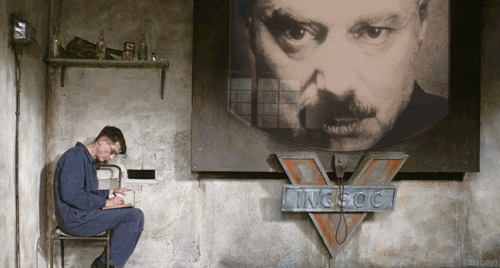
When I read 1984 last summer, I was most intrigued by the eerily accurate parallels between his dystopian society and modern-day America, from the constant surveillance by the NPA to the perpetual, practically meaningless conflict our country involves itself with. While it was obvious that Orwell intended for the book to remind the populace about the dangers of communism and totalitarianism in the wake of World War II, he painted a picture of an empire that the United States disturbingly appears to imitate.
Now, many argue that the United States, due to its dedication towards maintaining freedom, must be good and therefore cannot be an empire, for we have come to associate empire with lebensraum, genocide, and dictatorship when in reality an empire’s primary affiliation lies with the acquisition and maintenance of power, whether that be through ideological, military, or economic means. The United States maintains its empire using all of the above: the country spreads its ideology throughout the world via Hollywood, McDonalds, and the internet; it secures its dominance militarily by posting troops in Germany, Japan, South Korea and dozens of other countries; and it asserts its power economically by promoting capitalism to keep a free market for its goods and services.

The most interesting idea in 1984 was using violence to maintain order. This concept is similarly reflected in J.M. Coetzee’s Waiting for the Barbarians which emulates the theory of an empire. We can draw a parallel between O’Brien from the former and Colonel Joll from the latter, both of whom manipulate peoples’ conceptions of the truth with pain. In regard to the United States, we have seen justifications of “enhanced interrogation” to acquire the “truth.” However, in all of the three scenarios, none admit to utilizing torture, instead drawing upon euphemisms to justify their means.
"The war is waged by each ruling group against its own subjects, and the object of war is not to make or prevent conquests of territory, but to keep the structure of society intact...It would probably be accurate to say that by becoming continuous war has ceased to exist...A peace that was truly permanent would be the same as a permanent war." - George Orwell, 1984
In addition, the need for war prevails in both novels. In 1984, Oceania (the protagonist’s home) is in constant war with either Eurasia or Eastasia while in Waiting for the Barbarians, the Empire chooses to fight the barbarians (After all, nothing unifies people more than a common enemy). The United States, for example, has been at war with one country or another for the majority of its existence from the American Revolution to the Civil War to the current War on Terrorism (2001-present). While we can say that we have moral/logical justification for war, the economic and political reasons are also obvious and greatly resemble an empire’s reasons for invading land (our country is, after all, a conglomeration of stolen lands primarily from Native Americans).

Now, I think that I have ranted for long enough, so it’s your turn: Whether the United States emulates the Oceanian Party, whether it is a pillar of democracy securing freedom, or whether it is something else altogether (not even an empire), you decide.
Works Cited
Brown, Daniel, and Skye Gould. “The US Has 1.3 Million Troops Stationed around the World - Here Are the Major Hotspots.” Business Insider, Business Insider, 31 Aug. 2017, www.businessinsider.com/us-military-deployments-may-2017-5/#of-the-us-navys-seven-fleets-three-are-deployed-in-or-near-potential-hotspots-around-the-world-3.
Coetzee, J M. Waiting for the Barbarians. Penguin Books, 2010.
Grossman, Zoltan. “History of U.S. Military Interventions since
1890.” Academic Computing at Evergreen, Evergreen State College, Oct. 2001, academic.evergreen.edu/g/grossmaz/interventions.html.
Orwell, George. 1984: A Novel. Signet Classics, 2015.
*Gifs courtesy of tumblr
Comments